Podoplanin 2025
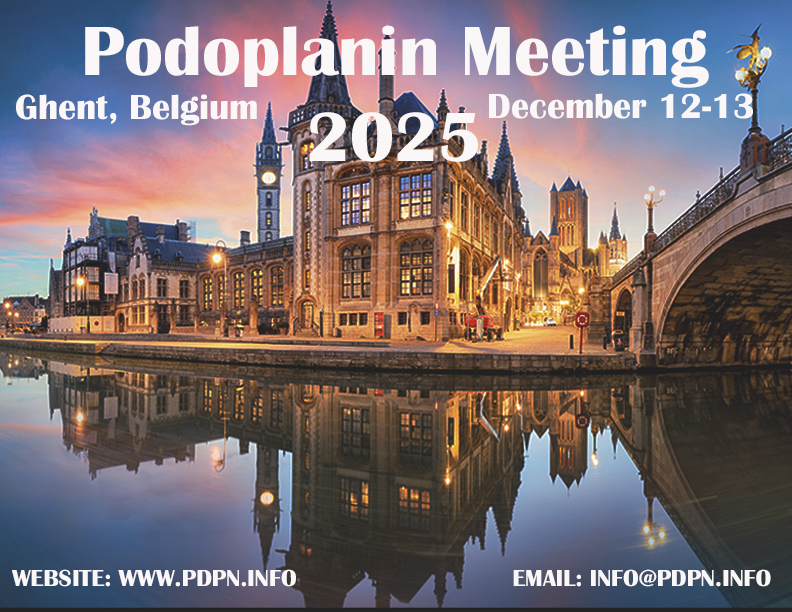
The 2025 International PDPN Meeting was held on Dec 12-13 in Ghent Belgium.
The meeting started with seminars about PDPN in malignancies.
- Gary Goldberg and Cayla Holdcraft (Rowan University) talked about “Targeting PDPN on transformed cells that escape contact normalization”.
- Ariel Yin and Francesca Frontera (Rowan University) talked about “Effects of MASL on human OSCC cell motility, viability, and PDPN expression in situ and in vitro” and described “a new Spa1 anti-human PDPN antibody and Dynamic Cell Migration Chambers”.
- Harini Krishnan (Stony Brook University) talked about “Probing the nature and significance of alternative PDPN glycosylation”.
- Luís Monteiro (IUCS-CESPU – Portugal) talked about “Podoplanin expression in oral cancer and oral potentially malignant disorders”.
- Yunsheng Chen (Sun Yat-sen University) described how “PDPN-mediated CAF activity enhances invasion and migration of cancer stem cells”.
- This session concluded with Kazue Yoneda (Hyogo Medical University) talking about “Blood-based biomarkers in thoracic malignancies”.
The second session focused on PDPN in blood and skin.
- Maria Cimini (Temple University) talked about “Podoplanin expression in the heart: an overview”.
- Steve Watson (University of Birmingham) talked about “Using nanobodies to study the organization of CLEC-2 and related receptors on platelets”.
- The session concluded with Ester Martín Villar (Francisco de Vitoria University) presenting “From development to regeneration: the role of podoplanin in skin”.
The final session focused on PDPN and inflammation.
- Vijay Kuchroo (Harvard University) talked about the “Role of PDPN in regulating allergic inflammation”.
- Spiros Makris (University College London) talked about “Lymph node fibroblast phenotypes and immune crosstalk regulated by podoplanin activity”.
- The session concluded with Jonas Steenbrugge (Ghent University) talking about how “Chitinase 3-like 1 stimulates immunosuppression and macrophage-mediated lymphatic remodeling in mammary tumors”.
We are grateful to the speakers and attendees for engaging talks and conversations. The venue served well to advance research into the role of PDPN on a variety of topics and how to leverage our knowledge to generate reagents and protocols to understand and treat maladies including cancer and inflammatory syndromes.